Electric tankless water heater requirements: amps, kW and your panel
A whole-house electric tankless heater needs 240 V and a very large current: about 75 A at 18 kW and 150 A at 36 kW (kW ÷ volts), often over several circuits. Only a licensed electrician can confirm that your panel and service can carry the exact model.

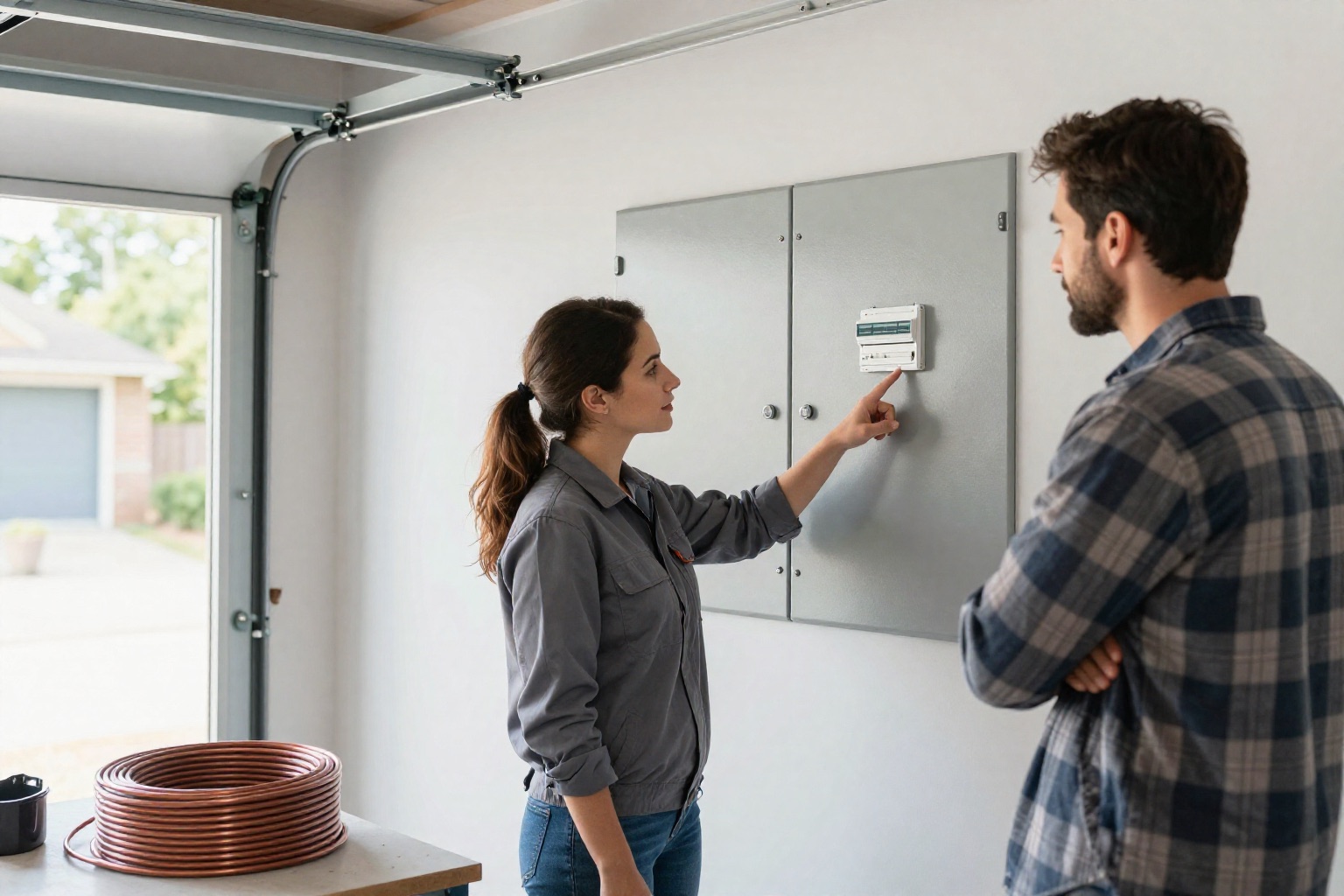
A whole-house electric tankless water heater needs 240 V and a lot of current: an 18 kW unit draws 75 A, a 27 kW unit about 113 A and a 36 kW unit 150 A. That load is split over two to four double-pole breakers, and makers ask for a 150 A to 300 A main service. Size the heater from your winter flow first, then let a licensed electrician confirm your panel can carry it.
Affiliate disclosureAs an Amazon Associate we earn from qualifying purchases made through links on this page. Commissions never change our ratings.
How many amps an electric tankless heater draws
The arithmetic is simple: watts divided by volts gives amps. At 240 V, every 1 kW of heating power is a bit over 4 A. That is why the manufacturers print their electrical requirements right next to the flow charts: a whole-house unit is a very large load.
| Model | Power | Current draw | Breakers (double pole) | Main service asked for |
|---|---|---|---|---|
| Rheem RTEX-18 | 18 kW | 75 A | 2 × 40 A | 150 A |
| Rheem RTEX-24 | 24 kW | 100 A | 3 × 40 A | 200 A |
| Rheem RTEX-27 | 27 kW | 113 A | 3 × 40 A | 200 A |
| Rheem RTEX-36 | 36 kW | 150 A | 4 × 40 A | 300 A |
| Stiebel Eltron Tempra 24 Plus | 24 kW | 2 × 50 A | 2 × 50 A | 150 A |
| Stiebel Eltron Tempra 29 Plus | 28.8 kW | 3 × 40 A | 3 × 40 A | 200 A |
| Stiebel Eltron Tempra 36 Plus | 36 kW | 3 × 50 A | 3 × 50 A | 300 A |
Two things stand out. First, the heater is fed by several separate circuits, each with its own breaker and its own run of wire: Rheem specifies 8 AWG copper with 75 °C insulation for each run, Stiebel Eltron 8/2 AWG copper sized to keep voltage drop under 3 %. Second, the service size matters as much as the breakers. A 100 A panel that already runs a range, a dryer and central air has no room for 113 A more, however many empty slots it shows.
What size electric tankless water heater do you need?
This is the question most people type in first, and the answer is flow, not house size. Add up the hot water you run at the same time, then check what the heater delivers at your groundwater temperature. Rheem publishes that table for its RTEX range, calculated to a 105 °F shower temperature:
| Model | 37 °F (far north) | 47 °F | 57 °F | 67 °F | 77 °F (far south) |
|---|---|---|---|---|---|
| RTEX-18 (18 kW) | 1.8 | 2.1 | 2.6 | 3.2 | 4.4 |
| RTEX-24 (24 kW) | 2.4 | 2.8 | 3.4 | 4.3 | 5.9 |
| RTEX-27 (27 kW) | 2.7 | 3.2 | 3.8 | 4.9 | 6.6 |
| RTEX-36 (36 kW) | 3.6 | 4.2 | 5.1 | 6.5 | 8.8 |
A standard showerhead runs at 2.5 GPM and a WaterSense model at 2.0 GPM or less. So in a cold-water state, 18 kW is roughly one shower at a time, and two showers plus a sink need 27 to 36 kW, which is exactly where the electrical bill of materials gets heavy. Stiebel Eltron gives the same physics as a formula: GPM = kW × 6.83 ÷ temperature rise in °F. A 28.8 kW Tempra 29 lifting 47 °F water to 105 °F (a 58 °F rise) gives about 3.4 GPM.
Our sizing guide walks through the flow side in detail, and the flow-rate calculator runs it for your fixtures.
Panel, service and the questions for your electrician
Rheem says it plainly on its sheet: when you swap an electric tank for an electric tankless unit, a panel upgrade is often required. The tankless unit that replaces the tank may want 113 A spread over three circuits. Before you order, give the electrician the exact model and ask:
- What is my main service rating, and what is the calculated load once this heater is added?
- Are there enough breaker spaces for two, three or four double-pole breakers, and does the panel accept them?
- Can the wire runs from the panel to the heater location be done at the gauge the manual asks for, and at what cost?
- Does the utility need to approve a service upgrade, and how long does that take where I live?
- Is a permit and inspection part of your quote?
If the answer is a new service, compare that cost with a gas unit (if you have gas) or a heat pump water heater before committing. Our gas vs electric guide lays out that trade-off.
Common mistakes with electric tankless heaters
- Buying on the box GPM. The headline flow is usually quoted for warm inlet water. In the coldest groundwater zone on Rheem’s chart, the same 18 kW unit gives less than half of its warm-water figure.
- Counting breaker slots instead of amps. Free spaces in the panel say nothing about service capacity.
- Ignoring the activation flow. Rheem RTEX units switch on at 0.3 GPM, Stiebel’s larger Tempras at 0.77 GPM. A low-flow bathroom faucet below that runs cold.
- Assuming the heater regulates for you. Stiebel’s Tempra Plus slightly reduces flow when demand exceeds its power to hold temperature; other units simply deliver cooler water. Neither creates extra capacity.
- Using a whole-house unit for one sink. A remote basin is often better served by a small point-of-use heater on its own circuit, as our point-of-use guide explains.
Which electric heaters in our ranking fit which house
All three top picks of our whole-house electric ranking run on 240 V. Match them to your climate and your panel:
- Rheem 18 kW Electric, 240V (rated 9.3/10): 18 kW. A good fit for one shower at a time in the South or for a small household; on Rheem’s RTEX-18 sheet the same power means 75 A on two 40 A breakers.
- Stiebel Eltron Tempra 29 Plus (rated 7.9/10): 28.8 kW with Advanced Flow Control, which trims flow to hold temperature when you ask too much. Stiebel asks for three 40 A breakers and a 200 A service.
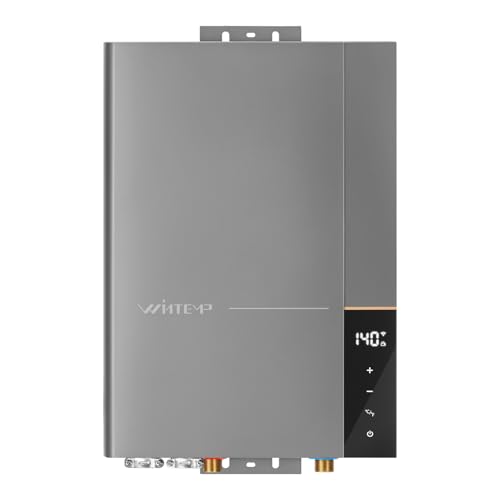
- WINTEMP WN-36kW Electric, 240V (rated 8.1/10): 36 kW, the most power in our top three and the right size for two showers in a cold climate, but at this power a 300 A service is what the manufacturers in the table above ask for.
If your service tops out at 100 to 150 A, the honest answer may be a smaller unit for one bathroom, or gas. Small 120 V units are a different category again, covered in our guide to under-sink tankless water heaters.
Our rated picks
The three best-rated models of our ranking Best Whole-House Electric Tankless Water Heaters in 2026, from the buyer review record and the listed specs.
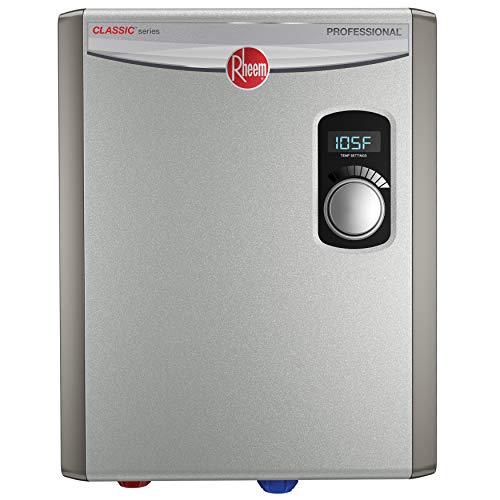

Product images: Amazon listings
Rankings for this question
Common questions
What size electric tankless water heater do I need?
Add up the flow of the fixtures you run together, then read the maker’s chart at your groundwater temperature. On Rheem’s chart an 18 kW unit gives 1.8 GPM with 37 °F water and 4.4 GPM with 77 °F water, so cold regions usually need 27 to 36 kW for two showers.
How many amps does a tankless water heater use?
Divide watts by volts. At 240 V an 18 kW unit draws 75 A, 24 kW draws 100 A, 27 kW about 113 A and 36 kW 150 A, split over two to four double-pole breakers.
Do I need a 200 amp panel for a tankless water heater?
For most 24 to 29 kW models, yes: Rheem and Stiebel Eltron ask for 150 A to 200 A of main service, and 300 A for 36 kW units. An electrician confirms it with a load calculation for your house.
Does a gas tankless water heater need electricity?
Usually yes, but very little: the gas listings in our catalog that state a voltage give 120 V, for the fan, ignition and controls. They do not need the heavy 240 V circuits of an electric unit.
Sources
- Rheem — Professional Classic RTEX tankless electric water heaters, specification sheet (PDF) (consulted Nov 2026)
- Stiebel Eltron USA — Tempra Trend and Tempra Plus technical specifications (PDF) (consulted Nov 2026)
- Stiebel Eltron USA — Tempra Trend and Plus engineering specification sheet (PDF) (consulted Nov 2026)
- U.S. EPA WaterSense — Showerheads (consulted Nov 2026)
- U.S. Department of Energy, Energy Saver (archived May 31, 2026) — Sizing a New Water Heater (consulted Nov 2026)