Under-sink tankless water heaters: what a 120 V unit can heat, and what it can't
A 120 V under-sink tankless heater tops out around 3.5 kW, enough to warm about half a gallon a minute by roughly 48 °F: right for washing hands, nowhere near a shower. A kitchen sink wants a 240 V unit of 11 to 12 kW, and one shower starts around 14 kW.

Most people looking for an instant hot water heater under the sink have one annoying tap: the powder room at the end of the hall, the basement bar sink, the garage. A small tankless unit fixes that wait. What it can't do is turn a 120 V circuit into a whole-house heater, and plenty of listings blur that line. Here's the arithmetic we'd run before buying, and the models in our catalog that survive it.
Affiliate disclosureAs an Amazon Associate we earn from qualifying purchases made through links on this page. Commissions never change our ratings.
Three things sold as instant hot water under the sink
Search for an instant hot water heater for under the sink and you'll get three different products. A point-of-use tankless heater, the subject of this guide, heats water only while it flows through. A mini-tank heater keeps a few gallons hot in a small tank that lives in the cabinet. And a hot water dispenser is a separate little faucet for near-boiling water, handy for tea, useless for washing up. Only the first one gets rid of the wait at a sink without storing anything.
A point-of-use unit earns its keep when the problem is distance, not capacity. Your main heater is fine, but the powder room at the far end of the house, the basement bar sink or the garage takes a full minute to run warm. If the real complaint is that the house runs out of hot water, a small box won't fix it, and our point-of-use vs whole-house guide explains why. In our catalog, four tankless listings state a 110 V or 120 V supply, and twelve more state 240 V at 6 to 15 kW.
What 3.5 kW does at the tap
Every electric heater plays by the same rule. One kilowatt makes 3,412 BTU an hour, and lifting one gallon a minute by one degree takes 500 BTU an hour. So the flow you can count on is roughly kW × 6.8 ÷ the temperature rise in °F. No amount of marketing changes that, which is good news, because it means you can check any listing yourself.
| Flow | Rise | 42 °F water | 52 °F water | 62 °F water |
|---|---|---|---|---|
| 0.5 GPM low-flow aerator | 48 °F | 90 °F | 100 °F | 110 °F |
| 1.0 GPM bathroom sink | 24 °F | 66 °F | 76 °F | 86 °F |
| 1.5 GPM kitchen sink | 16 °F | 58 °F | 68 °F | 78 °F |
| 2.0 GPM shower | 12 °F | 54 °F | 64 °F | 74 °F |
The first row is why Rheem writes "3.5 kW model provides up to 0.5 GPM" in its listing. At half a gallon a minute you get a properly warm hand wash in most of the country: 100 °F with 52 °F water coming in. Open the tap to a normal 1.0 GPM and the same heater hands you 76 °F water. That's technically warm, and not much fun in February.
So our rule for any 120 V unit is simple: pair it with a 0.5 GPM aerator and treat it as a hand-wash heater. Ask it to fill a pot at the kitchen sink and you'll be disappointed.
120 V means amps, and the outlet under the sink won't do
3.5 kW at 120 V is about 29 A. A standard 15 A household circuit is built for about 1,800 W at 120 V, so even the smallest of these heaters wants a circuit of its own. Rheem spells it out: its listing asks for a 30-amp single-pole breaker and #10 AWG copper conductors, and recommends a 100-amp service panel. The 3,000 W 110 V xwdzswgs under-sink unit asks for "trip switches of over 32A".
Don't plan on plugging one into the outlet behind the trash can. Before you order, ask a licensed electrician whether your panel has room for one more dedicated circuit and what running it to that sink would involve. That answer decides whether the 120 V route makes sense at all. Our electrical requirements guide lists the questions to bring.
Can a 120 V tankless heater run a shower?
Not one you'd want to stand under. A shower at 2.0 GPM heated to 105 °F needs about 12.6 kW with 62 °F water, 15.5 kW at 52 °F and 18.5 kW at 42 °F. At 120 V, even the smallest of those numbers would mean more than 105 A. A 3.5 kW unit lifts that shower by 12 °F.
The honest listings say so in writing. HNK titles a bullet "Suitable For Sinks, Not For Shower" and adds the exception "Unless the water temperature is higher than 77 degrees Fahrenheit". The xwdzswgs listing goes further: "Not Suitable for showers (Shower normally requires at least 1.8 GPM)". Even the 77 °F exception is generous. With 77 °F water, 3.5 kW takes a 1.5 GPM low-flow shower to about 93 °F. Fine for rinsing sand off your feet at a beach house; not a shower in January.
If you came here for the best 110 volt tankless water heater for a shower, that's the answer nobody likes: there isn't one worth buying. You need 240 V, and the section after next shows where the useful range starts.
Read the flow claims twice
Because the arithmetic is fixed, any listing takes ten seconds to check: kW × 6.8 ÷ rise. Some pass easily. EcoSmart says the ECOS 12 "provides between 1.3 and 3.1 gallons-per-minute depending on the inlet water temperature", which is exactly what 12 kW does between a 63 °F and a 26 °F rise. Rheem's 8 kW and 11 kW figures, 1.95 and 2.68 GPM, both work out at a rise of about 28 °F, so read them as warm-weather numbers.
Others don't pass. Westinghouse writes "When inlet temperature is 62°F and outlet is set to 105°F, flow reaches 2.6 GPM" for its 11 kW unit; at that 43 °F rise, 11 kW covers about 1.7 GPM. Its 14 kW sibling claims 3.4 GPM on the same terms, where the arithmetic gives about 2.2. And the 3,000 W 110 V listing promises a rise of 82 °F at 0.3 GPM and 131 °F at 0.5 GPM: more flow can't produce more rise, and 3,000 W lifts half a gallon a minute by about 41 °F.
None of that makes these heaters useless. We'd just plan with our number, not theirs.
When to step up to 240 V point of use
Double the voltage and the same current carries twice the heat. That's where under-sink units start doing real work: a kitchen sink, a pair of bathroom sinks, one low-flow shower. Here are the 240 V units in our catalog between 6 and 15 kW, with the flow each one can hold at a 53 °F rise (52 °F water heated to 105 °F):
| Model | Stated power | Flow at 53 °F rise | Price |
|---|---|---|---|
| Rheem RTEX-06T, 6.5 kW 240V | 6.5 kW | 0.8 GPM | $189 |
| Stiebel Eltron DHX 8-2 Trend, 7.2 kW | 7.2 kW | 0.9 GPM | $265 |
| Rheem 8 kW Multi Fixture, 240V | 8 kW | 1.0 GPM | $236.61 |
| Westinghouse 11 kW Electric, 240V | 11 kW | 1.4 GPM | $259.99 |
| Rheem 11 kW Multi Fixture, 240V | 11 kW | 1.4 GPM | $267.62 |
| EcoSmart ECOS 12, 12 kW 240V | 12 kW | 1.5 GPM | $259.02 |
| Stiebel Eltron DHX 12-2 Trend, 12 kW | 12 kW | 1.5 GPM | $266.14 |
| ThermoMate 14 kW Electric, 240V | 14 kW | 1.8 GPM | Currently unavailable |
| ORBEK 14 kW Electric, 240V | 14 kW | 1.8 GPM | $179.99 List price |
| Westinghouse 14 kW Electric, 240V | 14 kW | 1.8 GPM | $239.99 List price |
Our rough guide from those numbers: around 7 kW still falls short of a 1.0 GPM bathroom faucet (0.9 GPM at 7.2 kW), 11 to 12 kW handles a 1.5 GPM kitchen sink, and 14 kW gives about 1.8 GPM, enough for one 1.5 GPM low-flow shower. ThermoMate is refreshingly straight about its 14 kW unit: up to "1-2 plumbing fixtures simultaneously" depending on your inlet temperature, a dedicated 60 Amp double-pole circuit breaker and a panel of at least 150 Amps. ORBEK promises "2-3 points of use" for its 14 kW unit, which is optimistic in winter.
Fitting one under a sink: what to check first
- Activation flow. A heater only fires above a minimum flow. Bosch states "as low as a 0.55 GPM activation flow rate" for its Tronic 4000, which is fine for a normal faucet but sits above the 0.5 GPM a 120 V unit is built around. If you fit a low-flow aerator, make sure the heater still switches on at that flow.
- Mounting position. Some units have to hang one way only: the xwdzswgs listing says "vertical installation only". Measure the cabinet with the drain trap and the shut-off valves in place, not the empty box.
- Temperature control. Both 3.5 kW 120 V models we list, the Rheem and the EcoSmart POU 4T, say thermostatic in the title: they hold a set temperature as the flow changes, up to the limit of their power.
- Warranty and access. Rheem covers its 3.5 kW unit with a "5-Year Leak, 1-Year Parts" warranty. Leave room to reach the fittings; a slow drip inside a closed cabinet is the kind of thing you find months late.
Our shortlist, by job
For a single hand sink on 120 V, the Rheem 3.5 kW Point-of-Use is the one we'd buy. It's rated 7.0/10, the listing is clear about what it needs, and it was $189. The EcoSmart POU 4T is the same size on paper and rated 6.0/10, but its listing tells you far less.
For a kitchen sink or a small bathroom, go 240 V. The EcoSmart ECOS 12 (7.5/10, $259.02) states an honest flow range and a 50 A draw. For one shower in a mild climate, look at the ThermoMate 14 kW (7.9/10, Currently unavailable) or the cheaper ORBEK 14 kW (7.7/10, $179.99 List price $229.99 -22%). Prices are from Nov 22, 2026 and may have changed.
And if what you really want is a hot shower anywhere in the house, stop shopping under the sink. The Rheem 18 kW is #1 of our whole-house electric ranking at 9.3/10, with 2,187 buyer reviews averaging 4.2/5. Gas or electric, our whole-house tankless ranking puts both side by side.
Our rated picks
Three heaters for three jobs: the Rheem 3.5 kW Point-of-Use for one hand sink on 120 V, the EcoSmart ECOS 12 for a kitchen sink on 240 V, and the Rheem 18 kW, #1 of our whole-house electric ranking, if what you want is a shower.


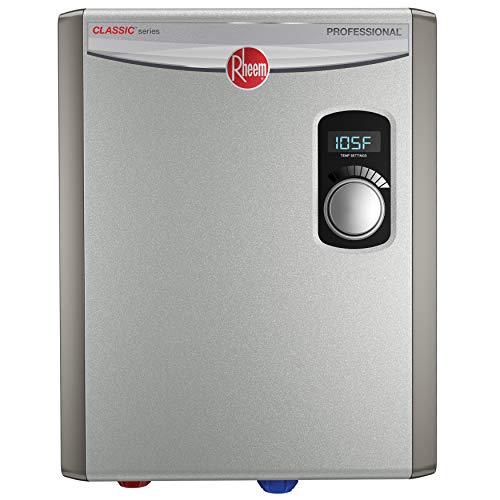
Product images: Amazon listings
Rankings for this question
Common questions
Can a 120V tankless water heater run a shower?
Not in any useful way. A 2.0 GPM shower heated to 105 °F needs about 12.6 to 18.5 kW depending on your water temperature; a 120 V unit tops out around 3.5 kW and lifts that shower by about 12 °F. For a shower you need 240 V, starting around 14 kW in a mild climate.
What is the best under sink tankless water heater on 120V?
For a single hand sink, the Rheem 3.5 kW Point-of-Use, rated 7.0/10. Its listing states up to 0.5 GPM and spells out the 30-amp breaker it needs. Pair it with a 0.5 GPM aerator.
How hot does a 3.5 kW under-sink heater get the water?
It adds about 48 °F at 0.5 GPM and about 24 °F at 1.0 GPM. With 52 °F water coming in, that's roughly 100 °F and 76 °F at the faucet.
Can I plug an under-sink tankless water heater into a regular outlet?
Don't count on it. A 3.5 kW unit draws about 29 A at 120 V, and Rheem's listing asks for its own 30-amp breaker. Have a licensed electrician check your panel before you buy; we give no wiring instructions.
What is the best point of use water heater for a kitchen sink?
A 240 V unit of 11 to 12 kW. The EcoSmart ECOS 12 (7.5/10) states 1.3 to 3.1 GPM depending on your water temperature, about 1.5 GPM at a 53 °F rise, which covers a 1.5 GPM kitchen faucet.
What size electric tankless water heater do I need for one shower?
About 12.6 kW with 62 °F water, 15.5 kW at 52 °F and 18.5 kW at 42 °F for a 2.0 GPM shower; a 1.5 GPM head brings that down to 9.5 to 13.8 kW. Our flow-rate calculator does the arithmetic, and the whole-house electric ranking starts at 18 kW.
Sources
- Rheem Canada — Chauffe-eau sans réservoir électriques Professional Classic, fiche technique (PDF) (consulted Nov 2026)
- Stiebel Eltron USA — Tempra Trend and Plus engineering specification sheet (PDF) (consulted Nov 2026)
- U.S. Department of Energy, Energy Saver (archived May 31, 2026) — Sizing a New Water Heater (consulted Nov 2026)
- U.S. EPA WaterSense — Showerheads (consulted Nov 2026)
- U.S. Energy Information Administration — British thermal units (Btu) (consulted Nov 2026)