Tankless water heater buying guide: how to choose one
Choose a tankless water heater from the hot water your house pulls at one moment and the coldest water it starts from, then the fuel you actually have. A model that delivers that flow at your winter rise, with an install your house can take, beats any headline GPM.


To choose a tankless water heater, add up the hot water you use at the same moment, work out how much the water has to be heated in winter, and buy a model that delivers that flow at that rise on the fuel you have. As a rule of thumb from the Department of Energy, a gas unit manages about 5 GPM at a 70 °F rise and an electric unit about 2 GPM. Then check that your gas line, vent route or electrical panel can take it.
Affiliate disclosureAs an Amazon Associate we earn from qualifying purchases made through links on this page. Commissions never change our ratings.
Step 1: add up your peak flow
List the hot-water uses that really overlap in your house, the morning rush is usually the worst case, and add their flow rates. The Department of Energy’s own example is a faucet at 0.75 GPM plus a shower at 2.5 GPM, so the heater must deliver at least 3.25 GPM. If you don’t know a fixture’s flow, time how long it takes to fill a bucket.
| Fixture | Flow |
|---|---|
| Low-flow faucet | 0.5 GPM |
| Bathroom faucet | 1 GPM |
| Kitchen faucet | 1.5 GPM |
| Shower, standard head | 2.5 GPM (WaterSense heads: 2.0 GPM or less) |
| Dishwasher | 2 GPM |
| Washing machine | 3 GPM |
Swapping two old showerheads for WaterSense ones takes a full gallon a minute off your peak, which can mean a size smaller heater.
Step 2: find your temperature rise
Temperature rise is the shower temperature minus the incoming water temperature. The Department of Energy suggests assuming 50 °F incoming water if you don’t know yours, and 120 °F at the tap for most uses, which is a 70 °F rise. Groundwater is colder in the North: Rheem’s zone map runs from 37 °F to 77 °F. Use your coldest month, because that is when a heater that looked big enough falls short.
Every tankless heater is rated by the rise it can manage at a given flow. A unit that lists 10 GPM usually means 10 GPM at a small rise in warm water. The DOE’s typical figures, 5 GPM for gas and 2 GPM for electric at a 70 °F rise, are a better first filter. Our sizing guide shows the math, and the calculator does it for you.
Step 3: pick the fuel you actually have
| Gas (natural gas or propane) | Electric | |
|---|---|---|
| Flow at a 70 °F rise | About 5 GPM (DOE typical) | About 2 GPM (DOE typical); 3.6 GPM for a 36 kW unit in 37 °F water on Rheem’s chart |
| What the house needs | Often a larger gas line: ¾-inch where a tank needed ½-inch, plus a vent through the wall | 240 V, 75 to 150 A over several breakers, often a 150 to 300 A service |
| Efficiency (UEF) | About 0.81–0.82 non-condensing, 0.93–0.98 condensing | About 0.93–0.98 on the makers’ sheets, but electricity usually costs more per unit of heat |
| Venting | Yes | No |
If you have natural gas at the house, a gas unit is usually the way to get whole-house flow in a cold climate. Without gas, electric works well in warm regions or for smaller households; in the North it often runs into panel limits. Propane is the third option, with its own costs. Our gas vs electric and natural gas vs propane guides go deeper.
Step 4: check the install before the price
The heater is often the smaller part of the bill. According to the Building America guide, a gas tankless unit can need 199,900 BTU/h where a typical tank needs 40,000, so a ¾-inch branch line or even a bigger meter feed may be required. A condensing unit needs a condensate drain. An electric unit may need a panel upgrade. Get written quotes for the exact model, and read our guides to installation and install costs before you compare prices.
Step 5: the details that decide daily comfort
- Minimum flow. Many units only fire above a set flow; washing hands below 0.5 GPM can stay cold on some models. The figure is in the manual.
- Efficiency. Compare UEF only between heaters in the same bin, and remember ENERGY STAR starts at 0.95 for gas.
- Recirculation. A built-in pump shortens the wait for hot water at far taps, but can cause the brief “cold-water sandwich” between two draws.
- Scale. In hard-water areas, plan isolation valves for flushing from day one; the maintenance guide explains why.
- Indoor or outdoor. They are different models; see the indoor vs outdoor guide.
Which of our rated heaters fits which household
| Your situation | Start with | Why |
|---|---|---|
| Natural gas, 2–3 bathrooms, cold winters | MIZUDO 199,000 BTU Natural Gas Indoor (9.2/10) | 199,000 BTU/h, our top-rated gas unit |
| Natural gas, efficiency first | Rinnai RU199iN Condensing (7.8/10) | Condensing, up to 11 GPM on the listing |
| No gas, 240 V service with room | Rheem 18 kW Electric, 240V (9.3/10) | 18 kW, one shower at a time in most climates |
| Propane, outdoor install | FOGATTI Outdoor Propane Tankless (9.1/10) | Top of our outdoor propane ranking |
The full rankings: best tankless water heaters, whole-house gas and electric and whole-house electric.
Our rated picks
The three best-rated models of our ranking Best Tankless Water Heaters in 2026, from the buyer review record and the listed specs.

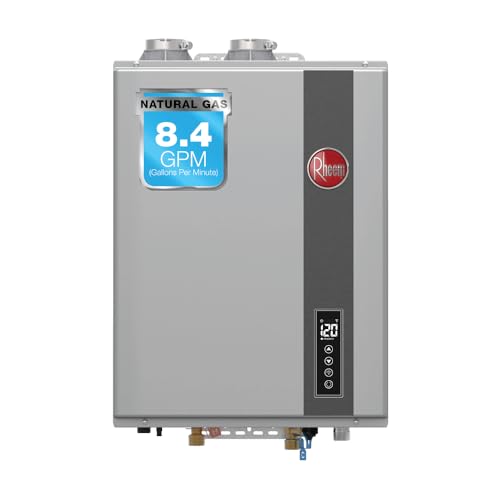

Product images: Amazon listings
Rankings for this question
Common questions
How do I choose the right tankless water heater?
Add up the flow of the fixtures you run together, subtract your winter inlet temperature from about 120 °F to get the rise, and pick a model whose chart covers that flow at that rise on your fuel. Then check the gas line, vent or electrical service with an installer.
What size tankless water heater do I need for a family of four?
Usually enough for two showers at once plus a faucet, about 5 to 6 GPM with standard heads or 4 to 5 GPM with WaterSense heads. In a cold climate that points to a whole-house gas unit around 199,000 BTU/h, or a 36 kW electric unit with a large service.
Is gas or electric better for a tankless water heater?
Gas gives more flow at a cold-weather rise, about 5 GPM against about 2 GPM for typical electric units according to the DOE. Electric is simpler to vent and install where the panel has room.
What should I look for when buying a tankless water heater?
Flow at your winter rise, the fuel and the install it needs, the UEF compared within the same bin, the minimum activation flow, the warranty on the heat exchanger and whether you can flush it easily.
Sources
- U.S. Department of Energy, Energy Saver (archived May 31, 2026) — Sizing a New Water Heater (consulted Nov 2026)
- PNNL Building America Solution Center (U.S. DOE) — Gas-Fired Tankless Water Heaters (consulted Nov 2026)
- Rheem — Professional Classic RTEX tankless electric water heaters, specification sheet (PDF) (consulted Nov 2026)
- U.S. EPA WaterSense — Showerheads (consulted Nov 2026)
- ENERGY STAR — Water Heater Key Product Criteria (consulted Nov 2026)
- U.S. Department of Energy, Energy Saver (archived May 18, 2026) — Estimating Costs and Efficiency of Storage, Demand, and Heat Pump Water Heaters (consulted Nov 2026)