Gas vs electric tankless water heater: which should you buy?
Buy gas if you already have a gas line with spare capacity and need two showers at once in winter; buy electric if your panel can carry 75 A or more and you want no vent at all. Neither wins by default: your demand, your groundwater and what your house can supply decide.


Gas tankless water heaters deliver more hot water in cold weather, about 5 GPM at a 70 °F rise against about 2 GPM for a typical electric unit, but they need a gas line big enough and a vent. Electric tankless heaters need no vent and are simpler to place, but a whole-house model draws 75 to 150 A at 240 V. If you have natural gas and a cold winter, gas usually wins; without gas, or in a warm climate with a big panel, electric can be the easier buy.
Affiliate disclosureAs an Amazon Associate we earn from qualifying purchases made through links on this page. Commissions never change our ratings.
Gas vs electric tankless: the comparison
| Gas | Electric | |
|---|---|---|
| Hot water at a 70 °F rise | About 5 GPM (DOE) | About 2 GPM (DOE); up to 3.6 GPM for 36 kW in 37 °F water |
| Typical burner or element size | 120,000–200,000 BTU/h | 18–36 kW for a whole house |
| Supply needed | Gas line often upsized (¾-inch branch instead of ½-inch), plus a 120 V outlet for controls on the listings that state one | 240 V, 75–150 A on 2–4 breakers, 150–300 A service |
| Venting | Yes, through a wall or roof; condensing units add a condensate drain | None |
| Efficiency on the label | UEF about 0.81–0.82 (non-condensing) to 0.93–0.98 (condensing) | UEF about 0.93–0.98 on manufacturers’ sheets |
| Utility impact | Gas load | High peak electrical load; costly under time-of-use rates |
The electric efficiency looks better on paper because almost no heat is lost up a flue. What you pay per gallon depends on your local price of a therm versus a kilowatt-hour: one therm is 100,000 Btu and one kWh is 3,412 Btu, so a therm of gas carries the heat of about 29 kWh.
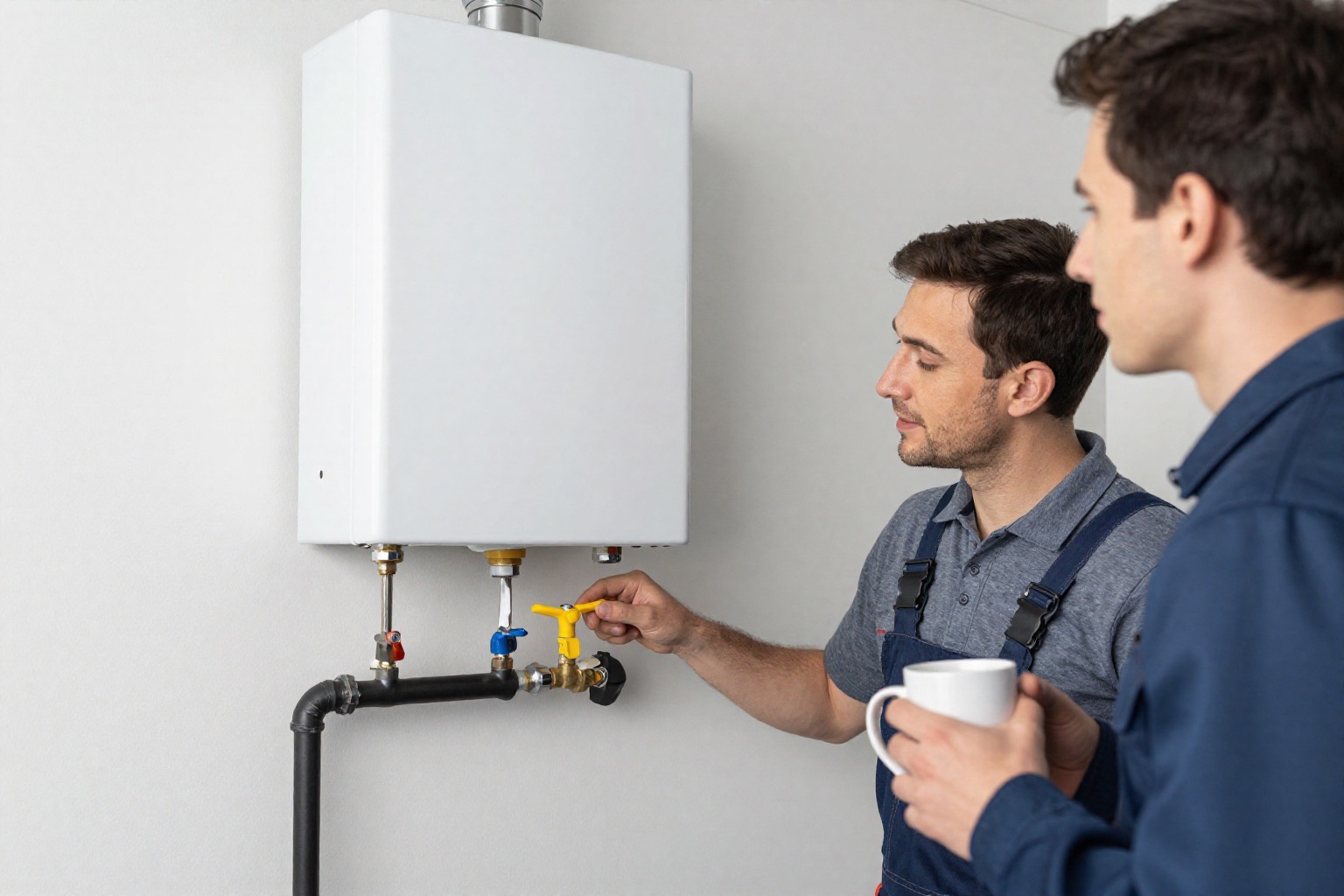
Which delivers more hot water in winter?
Gas, by a wide margin for whole-house use. The Department of Energy puts typical output at 5 GPM for gas and 2 GPM for electric at a 70 °F rise. Manufacturer charts agree: Rheem’s 18 kW RTEX gives 1.8 GPM with 37 °F groundwater, and even its 36 kW model only 3.6 GPM. A 199,000 BTU/h gas unit at 82 % efficiency puts about 163,000 BTU/h into the water, which is roughly 4.7 GPM at a 70 °F rise (heat ÷ (500 × rise), since one Btu heats a pound of water by 1 °F and a gallon weighs about 8.3 lb).
In the South, with 70 °F groundwater, the gap narrows a lot: an 18 kW electric unit covers one shower comfortably and 27 kW covers two.
What the install costs you, gas or electric
The Building America guide notes that a gas tankless heater can need 199,900 BTU/h of gas where a typical tank needs 40,000, so the gas line from the meter, and sometimes from the street, may have to be upsized. Add a new vent, and a condensate drain for a condensing model. Electric units skip all of that, but often need new circuits and, as Rheem warns on its sheet, a panel upgrade when you replace an electric tank.
- Already have gas at the water heater? Gas is usually the lower-risk install for a whole house.
- No gas in the street? Bringing it in costs far more than any heater; compare electric tankless with a heat pump water heater instead, which the Building America guide suggests when gas is not available.
- Under 150 A of service? A 27 to 36 kW electric unit may not fit without a service upgrade.
Our electrical requirements guide lists the amps and breakers model by model.
Running cost: what to compare
Compare cost per unit of heat, not efficiency alone. Take your gas price per therm and divide by the heater’s efficiency; take your electricity price per kWh, multiply by 29.3 (kWh per therm) and divide by the electric heater’s efficiency. Where electricity is cheap and gas expensive, electric can win; where gas is cheap, gas wins easily. Also note the Building America remark that electric tankless units create high peak loads, which hurts on time-of-use tariffs.
Common mistakes when choosing gas or electric
- Comparing UEF across fuels. A 0.98 electric heater can still cost more to run than a 0.82 gas one.
- Assuming an existing tank’s gas line is enough. A ½-inch line sized for 40,000 BTU/h rarely feeds 199,000.
- Ignoring winter. Electric units that look fine in a July showroom fall short in a January shower up North.
- Forgetting the outlet. Gas tankless heaters still need power for the fan and controls; the gas listings in our catalog that state a voltage give 120 V.
Which of our rated heaters for which case
- Natural gas, whole house: MIZUDO 199,000 BTU Natural Gas Indoor (rated 9.2/10) or, condensing, Rinnai RU199iN Condensing (rated 7.8/10).
- Propane, outside wall: FOGATTI Outdoor Propane Tankless (rated 9.1/10), our top outdoor propane unit.
- Electric, one shower at a time or a warm climate: Rheem 18 kW Electric, 240V (rated 9.3/10).
- Electric, two showers in a cold climate with a large service: WINTEMP WN-36kW Electric, 240V (rated 8.1/10).
See the full whole-house ranking, gas and electric. One labelling quirk: ENERGY STAR certifies gas tankless heaters but has no category for electric ones, as our Energy Star guide explains.
Our rated picks
The three best-rated models of our ranking Best Whole-House Tankless Water Heaters in 2026: Gas and Electric, from the buyer review record and the listed specs.


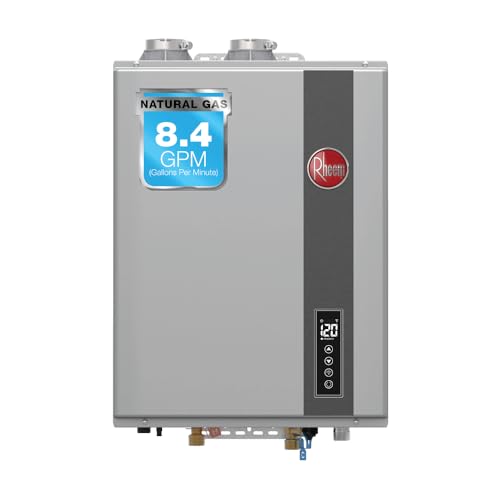
Product images: Amazon listings
Rankings for this question
Common questions
Is a gas or electric tankless water heater better?
Gas is better for whole-house use in cold climates, with about 5 GPM at a 70 °F rise against about 2 GPM for electric (DOE). Electric is better where there is no gas, no easy vent route, or warm groundwater and a panel with spare capacity.
Are tankless water heaters gas or electric?
Both exist. Gas models burn natural gas or propane and need a vent; electric models use heating elements on 240 V (or 120 V for small point-of-use units) and need no vent.
Is it cheaper to run a gas or electric tankless water heater?
It depends on your rates. A therm of gas carries the same heat as 29.3 kWh of electricity, so compare your price per therm with 29.3 times your price per kWh, each divided by the heater’s efficiency.
Do electric tankless water heaters work in cold climates?
Yes, but with less flow. With 37 °F groundwater Rheem’s 18 kW model gives 1.8 GPM and its 36 kW model 3.6 GPM, so two showers at once need the largest units and a big electrical service.
Sources
- U.S. Department of Energy, Energy Saver (archived May 31, 2026) — Sizing a New Water Heater (consulted Nov 2026)
- PNNL Building America Solution Center (U.S. DOE) — Gas-Fired Tankless Water Heaters (consulted Nov 2026)
- Rheem — Professional Classic RTEX tankless electric water heaters, specification sheet (PDF) (consulted Nov 2026)
- U.S. Energy Information Administration — British thermal units (Btu) (consulted Nov 2026)
- U.S. Geological Survey — Water Density (consulted Nov 2026)
- ENERGY STAR — Water Heater Key Product Criteria (consulted Nov 2026)