Energy Star tankless water heaters: what UEF qualifies, and which models get there
A gas tankless water heater earns ENERGY STAR with a UEF of 0.95 or higher, at least 2.8 GPM over a 67 °F rise and a 6-year heat exchanger warranty, which in practice means a condensing unit. Electric tankless heaters have no ENERGY STAR category, so the label only helps you choose between gas models.

Lots of tankless listings promise high efficiency. Few of them clear the line ENERGY STAR draws: in our catalog, only four gas listings state a UEF high enough. That's no reason to skip the rest, but it's worth knowing before you pay extra for a sticker or chase a rebate that may not apply to the heater in your cart.
Affiliate disclosureAs an Amazon Associate we earn from qualifying purchases made through links on this page. Commissions never change our ratings.
What Energy Star asks of a gas tankless heater
ENERGY STAR has one set of criteria for gas-fired instantaneous water heaters, and a model has to meet every line of it. Hitting the efficiency number alone doesn't earn the label.
| Criterion | Requirement |
|---|---|
| Uniform Energy Factor (UEF) | 0.95 or higher |
| Maximum flow | 2.8 GPM or more over a 67 °F temperature rise |
| Warranty | At least 6 years on the heat exchanger and 5 years on parts |
| Safety standard | ANSI Z21.10.3/CSA 4.3 |
| Gas input | Under 200,000 BTU/h (the program's definition of an instantaneous unit) |
UEF is the Department of Energy's rating for how much of the fuel ends up as hot water over a standard day of draws. At 0.95, roughly 95 % of the energy reaches your taps under the standard rating conditions, and most of the rest leaves with the exhaust. The flow line is there to keep very small heaters out, and the input cap explains why so many whole-house units stop at 199,000 or 199,900 BTU/h: ten of the gas listings in our catalog state an input in that band.
The warranty line is the one people forget. A heater can post a great UEF and still miss the label on paper if the maker covers the heat exchanger for fewer than six years.
Why only condensing units clear 0.95
A non-condensing heater sends its exhaust out hot, and that heat is simply gone. A condensing heater pushes the exhaust through a second heat exchanger and cools it until the water vapour in it condenses, and that's where the extra points of UEF come from. It also means a condensate drain and different vent pipe, which we come back to below.
Of the 101 complete gas heaters in our catalog, 26 listings state a UEF. Here is how they spread out:
| Stated UEF | Best-rated examples | Meets 0.95? |
|---|---|---|
| 0.81 9 listings | ThermoMate CZ422LP Propane Indoor, Westinghouse 120,000 BTU Propane Outdoor, APUS 95,000 BTU Propane Indoor | No Non-condensing |
| 0.82 8 listings | Rheem RTG 8.4 GPM Natural Gas Outdoor, Rheem RTG 7.0 GPM Natural Gas Outdoor, Rheem RTG 8.4 GPM Propane Indoor | No Non-condensing |
| 0.93 4 listings | Rheem RTGH 9.5 GPM Propane Indoor, Rheem RTGH 8.4 GPM Natural Gas Indoor | No, just under Condensing (most titles) |
| 0.94 1 listing | A. O. Smith 10 GPM Natural Gas Outdoor | No, just under Condensing (title) |
| 0.97 3 listings | Rinnai RX160iN Condensing Smart Sense | Yes, on UEF Condensing (title) |
| 0.98 1 listing | Rinnai SENSEI CX199iN Commercial | Yes, on UEF Not stated in title |
The split is blunt. Every listing at 0.81 or 0.82 is a non-condensing design, and the ones whose title says condensing start at 0.93. Only four listings state 0.95 or more. The Rheem RTGH line is the interesting near miss: a condensing unit with a solid review record whose stated 0.93 sits just under the line. It's a good heater; it just doesn't earn the label on that number.
Electric tankless: no Energy Star label to look for
ENERGY STAR's water heater program covers gas storage tanks, gas tankless units, heat pump water heaters, solar systems and a class of larger gas tanks. There is no category for electric tankless heaters. On the electric side it certifies heat pump water heaters and solar systems with electric backup, not resistance heaters.
That isn't a knock on electric units. A resistance heater turns nearly all the electricity it draws into heat at the unit (six of the 51 electric listings we carry make some version of a "99 %" claim), so there is no efficiency tier left to separate them. If you see an "Energy Star electric tankless water heater" for sale, read the listing twice. With electric, your running cost comes down to your rate per kWh and how much hot water you use, and the real hurdle is whether your panel can carry a whole-house unit. The electrical requirements guide covers that, and the whole-house electric ranking lists the units with the amps they need.
What 0.97 instead of 0.82 does to your gas bill
UEF works as a plain ratio: for the same hot water, gas use scales with one divided by the UEF. A 0.82 heater therefore burns about 18 % more gas than a 0.97 heater. Put the other way, the condensing unit uses about 15 % less, which is roughly $15 saved for every $100 you'd spend heating water with the non-condensing one. Against a 0.93 unit, the gap shrinks to about 4 %.
Now the price side, from two units of similar size. The Rinnai RX160iN Condensing Smart Sense (0.97 UEF, 9 GPM stated) was $1,442.70 and the Rheem RTG 9.5 GPM Natural Gas Indoor (0.82, 9.5 GPM stated) was $1,084.35 List price $1,243 -13%, about $358 apart before any installation. Prices are from Nov 22, 2026 and may have changed.
Here's the quick check we'd use: divide the price gap by 15 % of what you spend heating water in a year. That's your payback in years, before any difference in the install. A busy household with two showers every morning gets there much faster than a weekend cabin, and in the cabin the non-condensing heater is often the smarter buy. Also price the condensate drain and the vent run: the condensing vs non-condensing guide explains what changes.
How to check an Energy Star claim before you buy
Listings use the label loosely. In our catalog, two gas listings mention ENERGY STAR outright: the A. O. Smith 10 GPM Natural Gas Outdoor and the Rinnai RU199iN Condensing. The A. O. Smith listing also states a 0.94 UEF, which is under today's 0.95 line, so the wording may come from an earlier version of the criteria or from a sibling model number. None of that makes it a bad heater, but it's worth checking before you count on a rebate.
- Copy the full model number from the listing or the spec sheet, including the fuel suffix: natural gas and propane versions are separate models.
- Look it up in the ENERGY STAR product finder. If it isn't there, treat the claim as unconfirmed.
- Check the warranty terms against the six-year heat exchanger requirement; the Rinnai RX160iN Condensing Smart Sense listing states 15 years on the heat exchanger.
- Keep the model number, the invoice and the installer's paperwork together; you'll want all three if you claim a rebate.
Rebates and the federal tax credit in 2026
The federal credit most people have heard of, the Energy Efficient Home Improvement Credit, covered qualifying improvements made through December 31, 2025, according to the IRS. If your heater goes in during 2026, don't plan the budget around it. Even while it ran, the bar for gas water heaters wasn't ENERGY STAR alone: the IRS required the highest efficiency tier of the Consortium for Energy Efficiency, with a cap of $600 per item.
What's left is local. Utilities and states run their own rebates with their own lists and deadlines, and they change often. Ask yours which list it uses before you order, and don't let a rebate push you into a heater sized wrong for your house. We don't give tax advice; the IRS page in our sources is the reference.
Our shortlist if the label matters to you
Start with the condensing units. The Rinnai RU199iN Condensing leads our high-efficiency ranking, with 388 buyer reviews averaging 4.4/5, and its listing says ENERGY STAR qualified. The Rinnai RX160iN Condensing Smart Sense states a 0.97 UEF and a 15-year heat exchanger warranty, so it clears both lines on paper; it's rated 6.8/10 with 70 buyer reviews averaging 4.2/5.
If the price gap stings, the Rheem RTGH 8.4 GPM Natural Gas Indoor states 0.93 with a 15-year heat exchanger warranty and was $1,188 on Nov 22, 2026, a price that may have changed. On its stated UEF it isn't ENERGY STAR, but it gets you most of the way there. And if your house can't take a condensate drain or a new vent at all, skip the label and pick from the gas tankless ranking: a well-sized non-condensing heater beats a condensing one that's fighting its install.
Our rated picks
The three best-rated heaters of our high-efficiency ranking, rated on their buyer reviews and the specs each listing states. On efficiency, the Rheem RTGH 8.4 GPM Natural Gas Indoor states 0.93, the Rinnai RX160iN Condensing Smart Sense states 0.97 and the Rheem Prestige Condensing Natural Gas states no UEF.
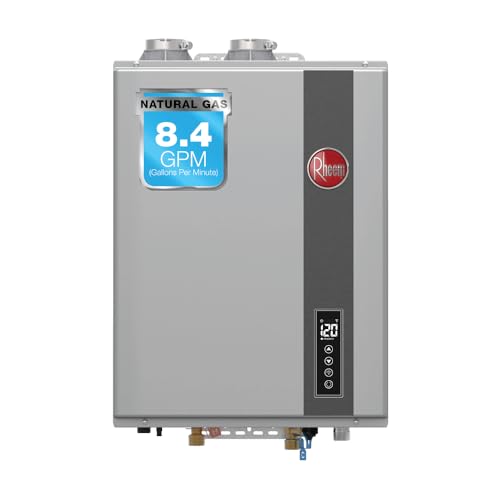

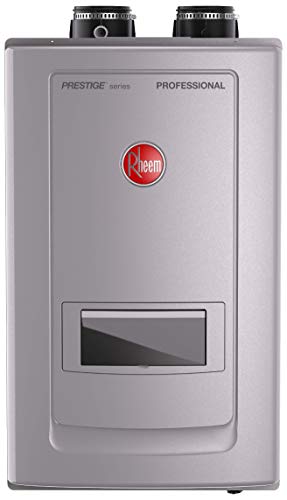
Product images: Amazon listings
Rankings for this question
Common questions
Are tankless water heaters Energy Star certified?
Gas ones can be. A gas tankless heater qualifies with a UEF of 0.95 or more, at least 2.8 GPM over a 67 °F rise and a warranty of 6 years on the heat exchanger and 5 on parts. In practice that means a condensing unit. Electric tankless heaters have no ENERGY STAR category.
What UEF does a tankless water heater need for Energy Star?
0.95 or higher. In our catalog, listings state UEFs from 0.81 to 0.98; only four reach 0.95, all of them from Rinnai. See the table in this guide.
Is there an Energy Star electric tankless water heater?
No. ENERGY STAR doesn't certify electric tankless units; for electric water heating it only certifies heat pump models. Compare electric tankless heaters on flow at your winter rise and on what your panel can carry, starting with our whole-house electric ranking.
Can I get a tax credit for an Energy Star tankless water heater in 2026?
Not the federal one most people mean. The IRS says the Energy Efficient Home Improvement Credit covered improvements made through December 31, 2025, and it required the CEE highest efficiency tier, not ENERGY STAR alone. Check your utility and your state for local rebates. This is not tax advice.
Which Energy Star gas tankless water heater should I buy?
Start with the Rinnai RU199iN Condensing, #1 of our high-efficiency ranking, whose listing says ENERGY STAR qualified, or the Rinnai RX160iN Condensing Smart Sense, which states a 0.97 UEF. Confirm the exact model number in the ENERGY STAR product finder before you count on a rebate.
Is a non-condensing tankless heater a bad buy if it isn't Energy Star?
Not at all. It uses about 18 % more gas than a 0.97 unit for the same hot water, but it usually costs less to buy and to install. In a small or part-time household, it is often the better deal. Our gas tankless ranking rates both kinds side by side.
Sources
- ENERGY STAR — Water Heater Key Product Criteria (consulted Nov 2026)
- PNNL Building America Solution Center (U.S. DOE) — Gas-Fired Tankless Water Heaters (consulted Nov 2026)
- U.S. Department of Energy, Energy Saver (archived May 18, 2026) — Estimating Costs and Efficiency of Storage, Demand, and Heat Pump Water Heaters (consulted Nov 2026)
- Internal Revenue Service — Energy Efficient Home Improvement Credit (consulted Nov 2026)
- ENERGY STAR — Water Heaters (Natural Gas) Tax Credit (consulted Nov 2026)